Forgotten Wealth Recovery in India

Forgotten Wealth Recovery in India
India is currently sitting on an astonishing pool of financial resources that remains completely unclaimed. Across commercial bank accounts, life insurance policies, corporate dividends, physical shares, and mutual fund folios, over ₹2.2 lakh crore in total wealth lies dormant. Millions of Indian families, along with Non-Resident Indians (NRIs), remain unaware that substantial sums of money left behind by parents or grandparents, or generated through early-career investments, are languishing in government-managed funds or corporate reserves.
This vast accumulation of forgotten capital stems from a common set of factors: historical paper-based record-keeping, frequent changes of residential address, outdated nominee records, incomplete Know Your Customer (KYC) details, and sudden loss of life without proper succession documentation. Over time, statutory mechanisms such as the Reserve Bank of India’s Depositor Education and Awareness (DEA) Fund, the Investor Education and Protection Fund Authority (IEPFA) under the Ministry of Corporate Affairs, and the Senior Citizens’ Welfare Fund (SCWF) absorb these funds.
Understanding search intent is critical when dealing with financial asset recovery. Informational intent drives individuals to learn why money becomes dormant and how regulatory frameworks operate. Commercial intent leads families to evaluate specialised recovery partners against time-consuming, self-managed bureaucratic routes. Transactional intent focuses on immediate execution—tracing lost folios, filing regulatory forms, updating bank details, and submitting transmission claims.
To begin searching for dormant holdings, auditing family financial histories, and navigating regulatory portals, explore modern asset recovery platform solutions to build a structured foundation for reclaiming financial legacy assets.
1. The Scale and Causes of Unclaimed Assets in India
The sheer volume of forgotten wealth in the Indian financial system highlights a widespread challenge in personal asset tracking and estate planning. Total unclaimed money across India exceeds ₹2.2 lakh crore, representing money that belongs to everyday citizens but sits idle due to administrative gaps and lost documentation.
Detailed Breakdown of Dormant Financial Capital
Unclaimed capital is distributed across multiple regulatory jurisdictions, financial institutions, and asset classes:
-
Bank Deposits (DEA Fund): More than ₹78,000 crore rests in dormant savings accounts, fixed deposits, and recurring deposits across public and private sector banks. Under banking rules, accounts that record no customer-initiated financial activity for ten consecutive years are deemed inoperative. At that point, banks transfer the principal balances and accrued interest into the Reserve Bank of India’s Depositor Education and Awareness (DEA) Fund.
-
Unclaimed Shares and Dividends (IEPF): Tens of thousands of crores in equity shares and unpaid corporate dividends sit with the Investor Education and Protection Fund Authority (IEPFA). When corporate dividend payments remain unencashed for seven consecutive years, Indian company law mandates that both the unpaid dividend amounts and the underlying equity shares be transferred directly to the IEPF.
-
Insurance Proceeds (SCWF): Unclaimed life insurance maturities, unpaid death claims, annuity payouts, and premium refunds account for nearly ₹14,000 crore across insurance providers. Insurers hold these unclaimed policy funds for up to ten years before transferring them to the Senior Citizens’ Welfare Fund (SCWF), where legal claimants can still initiate recovery within a statutory 25-year window.
-
Mutual Funds and Provident Funds: Unclaimed redemption proceeds and unassigned dividends in mutual fund schemes account for around ₹3,000 crore. Simultaneously, massive balances lie idle in untransferred Employee Provident Fund (EPF) accounts managed by the EPFO due to legacy employment changes, missing UAN linkages, and un-updated member records.
Primary Root Causes Behind Lost Capital
Financial assets rarely go missing due to deliberate neglect; rather, systemic life events, technological shifts, and procedural changes cause them to drop out of sight:
-
Physical to Digital Systemic Shift: Decades ago, stock markets operated using physical paper certificates, physical dividend warrants, and paper passbooks. During the systemic conversion to electronic dematerialization (demat), millions of paper certificates were misfiled, misplaced during house moves, or ruined due to poor physical storage.
-
Outdated KYC and Residential Records: Families moving across cities or shifting abroad often updated their local addresses without notifying every individual company registrar, bank branch, or asset management company (AMC). Consequently, dividend checks, redemption notices, and bonus share alerts bounced, prompting institutions to mark accounts as dormant.
-
Missing or Mismatched Nominations: Investors who purchased securities or opened bank accounts decades ago often left nomination sections blank or named individuals whose details changed over time. When the primary investor passes away without clear legal documentation, financial institutions freeze the accounts to protect themselves against competing claims.
-
Signature Mismatches: A common issue during physical asset recovery involves signature variation. Signatures recorded by a bank or Registrar and Transfer Agent (RTA) thirty years ago rarely match an aging investor's current signature, triggering immediate procedural rejections.
2. Real-World Recovery: The Story of the Kulkarni Family
To appreciate the complexity and transformative impact of recovering forgotten wealth, consider the experience of the Kulkarni family.
Anand Kulkarni was a dedicated civil engineer who retired in the late 1990s. Over his career, he systematically purchased physical shares in prominent Indian blue-chip companies, carefully placing the paper certificates in a metal trunk. When Anand passed away, his son, Vikram, who had moved to the United States for work, helped his mother settle their father's immediate bank accounts. However, the trunk containing the physical certificates remained unopened in their ancestral Pune home.
Two decades later, while renovating the property, Vikram rediscovered the trunk. Inside were yellowed, ageing share certificates from the 1980s and 1990s, along with stacks of unencashed dividend warrants. Over the years, the original companies had undergone corporate restructuring, name changes, stock splits, and bonus issuances. Furthermore, because no activity had taken place for over seven years, the companies had transferred both the unpaid dividends and the physical shares to the Investor Education and Protection Fund.
Initially, Vikram attempted to manage the recovery process independently. He contacted the company registrars but was immediately overwhelmed by the administrative demands. He faced signature mismatches from his father’s old records, missing original certificates, strict requirements for name alignment on current identity documents, and complex statutory claim forms (Form IEPF-5) requiring court-backed affidavits and indemnity bonds.
Realizing that navigating multiple regulatory channels from overseas was impractical, Vikram partnered with a specialized recovery advisory. The advisory systematically mapped the corporate history of each share, obtained duplicate certificate confirmations, aligned signature records through notarized bank verifications, and filed comprehensive claim dossiers with the IEPF Authority and company nodal officers.
Eighteen months later, the claim was approved. The accumulated dividends were credited directly to his mother’s bank account, and the dematerialized shares—now reflecting decades of corporate splits, rights issues, and bonus additions—were credited to a freshly opened demat account. The recovered asset value transformed the family's financial security, turning forgotten paper into a major liquid legacy.
3. The Legal and Regulatory Architecture for Asset Recovery
Reclaiming forgotten wealth in India requires navigating specific statutory portals and regulatory bodies. Each financial instrument falls under the authority of a dedicated regulator, and each requires a distinct recovery path.
Key Regulatory Frameworks and Portals
-
IEPF Portal (Form IEPF-5): Governed by the Ministry of Corporate Affairs (MCA), this platform processes claims for physical or demat corporate shares, unpaid corporate dividends, matured debentures, and company deposits that have remained unclaimed for seven or more years.
-
UDGAM Portal: Developed by the Reserve Bank of India (RBI), the Unclaimed Deposits – Gateway to Access iNformation portal serves as a centralized search engine across multiple public and private banks to identify dormant savings accounts, inoperative current accounts, and uncollected fixed deposits.
-
MF Central & MITRA Portals: Overseen by SEBI and operated jointly by CAMS and KFintech, these platforms help investors track unclaimed mutual fund redemption amounts, uncashed dividend balances, and inactive folios across all Asset Management Companies (AMCs).
-
Senior Citizens’ Welfare Fund (SCWF) & Insurer Portals: Governed by IRDAI and the Ministry of Finance, these channels manage unclaimed life insurance maturity proceeds, death claims, annuity payouts, and premium balances held by life and general insurance companies.
The Investor Education and Protection Fund Authority (IEPFA) Process
Under Section 125 of the Companies Act, 2013, companies must transfer all unclaimed dividends, matured deposits, debentures, and the associated shares to the IEPF if they remain unclaimed for seven consecutive years.
To reclaim assets from the IEPF:
-
Search and Trace: Investors or legal heirs search the IEPF portal using the investor's name, Permanent Account Number (PAN), Folio Number, or Depository Participant ID (DP ID).
-
E-Filing Form IEPF-5: The claimant files Form IEPF-5 on the Ministry of Corporate Affairs (MCA) portal, detailing the underlying investments, company records, and legal right to the claim.
-
Physical Verification Dossier: A physical verification packet—including the printed IEPF-5 form, advance receipt, indemnity bond stamped as per state laws, original share certificates (or loss affidavits), PAN, Aadhaar, and bank verification letters—must be submitted to the company's designated IEPF Nodal Officer.
-
Verification Report and Release: The company verifies the documents and submits an e-verification report to the IEPF Authority. Upon final approval, the authority issues an order directing the depository to transfer the demat shares and release the cash dividends directly to the claimant's verified bank account.
The RBI UDGAM Portal for Bank Accounts
To help the public search across multiple banks in one place, the Reserve Bank of India launched the UDGAM portal. UDGAM enables account holders and legal heirs to search for dormant savings, current, and fixed deposit accounts across major public and private banks using basic parameters such as name, PAN, address, or voter ID details.
Once a dormant deposit is identified, the claimant visits the home branch of the respective bank with current KYC documentation, original deposit receipts (if available), and proof of account ownership. If the original account holder is deceased, legal heirs must submit a formal transmission claim alongside the death certificate and proof of legal heirship.
Mutual Funds and the MF Central Portal
For mutual fund investments, the Securities and Exchange Board of India (SEBI) requires Asset Management Companies (AMCs) to publish details of unclaimed redemption amounts and unpaid dividends on their websites and through unified industry platforms such as MF Central’s MITRA portal.
Unclaimed mutual fund amounts continue to earn yields in specialized money market or liquid instruments managed by the AMC. Investors can initiate recovery by submitting updated bank mandate details, fulfilling modern KYC requirements, and verifying signatures through the respective Registrar and Transfer Agent (RTA), such as CAMS or KFintech.
4. Transmission vs. Recovery: Legal Heirs and Deceased Estates
A critical point of confusion during asset recovery is the structural difference between direct asset recovery initiated by a living investor and Asset Transmission executed on behalf of deceased estate legal heirs.
Deep-Dive Structural Comparison
-
Living Owner Recovery: When the primary investor is alive, the recovery process focuses entirely on documentation alignment. This includes resolving name variations through government gazette filings, updating legacy signatures via bank-attested Form ISR-2 filings, completing modern KYC validation, converting physical paper certificates into electronic demat holdings, and submitting direct Form IEPF-5 or bank claim forms.
-
Legal Heir Transmission: When the primary investor has passed away, the legal dynamics shift. Before assets can be recovered, claimants must establish legal ownership of the estate. This requires proving heirship through registered nominations, family trees, legal heir certificates, letters of indemnity, or court-issued documents such as probates or Succession Certificates.
Claiming Assets as a Legal Heir (Transmission Process)
When the original investor has passed away, the recovery process requires an extra legal layer: establishing legal ownership of the estate.
-
Cases with Registered Nomination: If the deceased investor registered a valid nominee with the bank, DP, or AMC, the process is streamlined. The nominee submits a Transmission Request Form (TRF), an official death certificate, notarized KYC documents, and updated bank details. The institution then transfers the assets into the nominee's name.
-
Cases Without Nomination (Simplified Thresholds): If no nominee was registered, financial institutions evaluate claims based on portfolio valuation thresholds established by SEBI and the RBI. For holdings falling below statutory limits (e.g., up to ₹5 lakh for physical shares or up to ₹30 lakh for demat holdings under SEBI guidelines), legal heirs can claim transmission by providing an affidavit, a letter of indemnity, and No Objection Certificates (NOCs) signed by all other legal heirs.
-
High-Value Claims Requiring Court Orders: For holdings exceeding simplified statutory thresholds, institutions require formal legal documentation issued by a competent civil court:
-
Probate of Will: A court-certified copy of a Will, confirming its authenticity and validating the executor's authority.
-
Succession Certificate: A certificate issued by a civil court establishing the legal heirs entitled to receive debts, securities, and financial assets when an individual dies intestate.
-
Letter of Administration: A court order appointing an administrator to manage and distribute an intestate estate.
-
5. Liquidity Management: Borrowing vs. Liquidating Recovered Wealth
Reclaiming long-forgotten financial assets often delivers a significant, unexpected boost to a family’s net worth. However, once those assets are credited back to active demat or bank accounts, families face a crucial strategic choice: should they sell the recovered holdings immediately for cash, or keep them invested to support long-term compounding growth?
Financial Comparison: Immediate Liquidation vs. Secured Borrowing
-
Outright Sale of Recovered Shares: Selling equity holdings or mutual fund units provides immediate cash liquidity. However, it triggers immediate Capital Gains Tax obligations (short-term or long-term depending on holding history), halts future compound growth permanently, forfeits recurring dividend income streams, and results in an irreversible loss of quality wealth holdings.
-
Secured Credit via Loan Against Securities (LAS): Pledging recovered securities to establish a credit line provides required cash while maintaining zero immediate capital gains tax triggers. The pledged portfolio remains active in the market, allowing the investor to continue earning corporate dividends, bonus issues, and long-term capital growth while paying flexible, overdraft-style interest strictly on drawn funds.
The Financial Cost of Immediate Asset Liquidation
When families recover high-value shares or mutual fund folios, their initial instinct is often to sell the assets to cover immediate personal needs, fund real estate purchases, or settle outstanding debts. While liquidation provides quick cash, it carries distinct drawbacks:
-
Capital Gains Tax Impact: Selling shares that have appreciated significantly over decades triggers substantial capital gains tax liabilities, reducing the net cash the family actually retains.
-
Loss of Future Dividend Streams: Many legacy holdings belong to established, dividend-paying companies. Selling those equities halts the steady, inflation-protected dividend income those stocks generate year after year.
-
Interruption of Compounding Growth: Selling high-performing stocks or mutual funds removes those assets from the market, forfeiting future compounding appreciation.
Unlocking Liquidity Without Selling Your Portfolio
A more tax-efficient alternative to immediate liquidation is using secured credit facilities, such as Loans Against Shares (LAS) or Loans Against Mutual Funds (LAMF).
Through specialized collateralized loan structures, investors can pledge their newly recovered equity shares or mutual fund units to a financial institution as security. The lender marks a digital lien over the securities, opening a flexible credit limit or overdraft facility without taking away ownership of the underlying assets.
Key benefits of secured borrowing against recovered assets include:
-
Preservation of Ownership: You remain the registered owner of the pledged shares and continue to receive all future dividends, bonus issues, and corporate rights benefits.
-
Tax Efficiency: Loan proceeds are treated as a credit liability rather than taxable income, meaning no capital gains taxes are triggered.
-
Flexible Overdraft Structures: You pay interest only on the exact amount you draw down and for the specific period you use the funds, rather than paying interest on a fixed lump sum.
-
Competitive Borrowing Costs: Because the loan is fully secured by quality liquid securities, interest rates sit well below those of unsecured personal loans or credit card lines.
Step-by-Step Action Plan for Tracing and Recovering Forgotten Assets
To efficiently locate and reclaim dormant financial assets, follow this structured execution plan across six critical phases:
-
Conduct a Comprehensive Home Financial Audit: Examine physical paper filing cabinets, safe deposit box inventories, old tax returns, dividend warrant slips, and historical bank passbooks. Record company names, folio numbers, bank account numbers, insurance policy details, and past residential addresses.
-
Search Official Digital Databases: Query official portals including UDGAM for bank deposits, the IEPF Search Portal for unpaid dividends and shares, and MF Central/MITRA for unclaimed mutual fund balances.
-
Align Identification and Signature Documentation: Secure updated identity proofs linking current credentials with legacy investment records. Complete bank-certified Form ISR-2 signature attestations to ensure current signatures match historical filings.
-
Submit Formal Recovery and Transmission Dossiers: Submit verified claim dossiers to bank branch managers, company IEPF Nodal Officers, or RTAs, including death certificates, indemnity bonds, and legal heir affidavits where required.
-
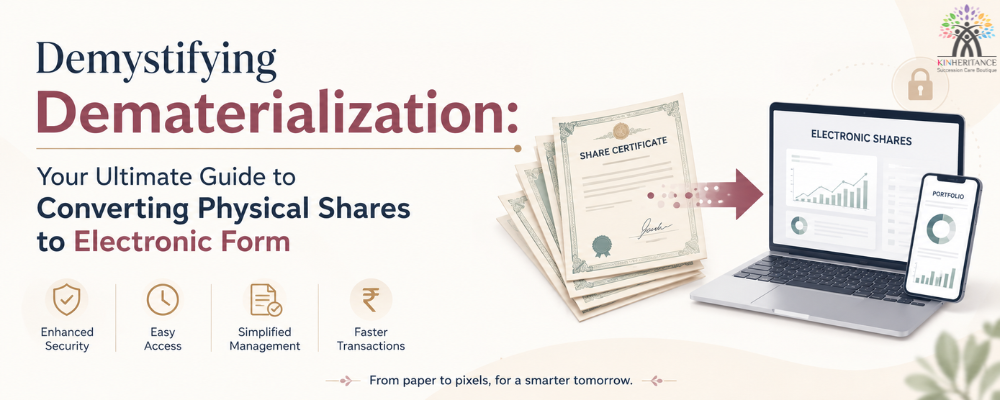
Convert Paper Certificates into Digital Demat Holdings: Submit physical share certificates along with a Dematerialization Request Form (DRF) to your Depository Participant (DP) to credit the shares electronically into your demat account.
-
Secure Recovered Assets with Estate Planning: Integrate recovered assets into a comprehensive succession framework by updating nominations, building a centralized digital inventory, and registering a legal Will.
How Kinheritance Helps You Reclaim Your Family Legacy
Navigating asset recovery in India involves coordinating with company registrars, banking managers, depository participants, legal authorities, and regulatory bodies. For many families and NRIs, managing these complex requirements across multiple cities or from overseas can be a daunting task.
At Kinheritance, we offer end-to-end, specialized guidance to help families trace, verify, and recover forgotten wealth:
-
Unclaimed Shares and Dividend Recovery (Kin-Unknown): Comprehensive assistance in tracing lost physical shares, recovering corporate dividends from the IEPF, resolving name or signature mismatches, handling duplicate share issuance, and completing complex asset transmissions to legal heirs.
-
Will Drafting & Estate Planning (Kin-Will): Legal expertise in drafting customized, enforceable Wills and setting up digital succession vaults so your recovered assets are passed on smoothly to future generations without legal hurdles.
-
Secured Liquidity Solutions (Kin-Loan): Immediate liquidity solutions that allow you to borrow against your equity and mutual fund portfolios without liquidating holdings or halting long-term growth.
Real Client Experience: Recovering Legacy Holdings for an NRI Family
A NRI family residing in London discovered an envelope containing physical share certificates issued in 1987 in the name of their late father. The certificates represented equity in a major Indian consumer goods conglomerate. Over thirty years, the company had undergone corporate name changes, stock splits, and multiple bonus issuances. Furthermore, because the family had moved overseas without updating their Indian address records, all dividends had remained unpaid, and the shares had ultimately been transferred to the IEPF.
Unfamiliar with Indian corporate law filings and unable to travel frequently to India, the family engaged Kinheritance to manage the recovery process.
The advisory team mapped the entire corporate history of the holdings, reconciled minor name variations on the late father's passport, coordinated with the company's RTA to obtain duplicate certificate confirmations, and drafted the required indemnity bonds and legal heir affidavits. The team filed Form IEPF-5 with the Ministry of Corporate Affairs and managed follow-up communications with the company's IEPF Nodal Officer.
Within fourteen months, the IEPF Authority approved the claim. The accumulated dividend proceeds were credited to a non-resident bank account, and the dematerialized shares—now valued at several times the original investment—were credited to a demat account opened for the legal heir. By relying on professional, process-driven support, the family successfully reclaimed its inheritance without disrupting its personal or professional life abroad.
Frequently Asked Questions (FAQs)
What is the IEPF, and why are shares transferred to it?
The Investor Education and Protection Fund (IEPF) is a government authority established under the Ministry of Corporate Affairs. Under Indian corporate law, if an investor does not claim dividends for seven consecutive years, the company must transfer both the unpaid dividend amounts and the corresponding shares to the IEPF. Claimants can recover these assets by filing Form IEPF-5.
Is there a time limit for reclaiming forgotten bank deposits from the DEA Fund?
No. Transferring dormant bank balances to the RBI's Depositor Education and Awareness (DEA) Fund does not extinguish the owner's or legal heir's right to the money. You or your legal heirs can claim the principal balance along with statutory interest at any time by submitting verified KYC documents to the bank.
How do I handle signature mismatches on old share certificates?
Signature mismatches are resolved by submitting SEBI Form ISR-2, which must be verified and stamped by your bank manager. The attestation confirms your current signature, identity proof, and active account details, allowing the Registrar and Transfer Agent (RTA) to update their records.
Can NRIs claim lost shares and bank deposits left behind in India?
Yes. NRIs can reclaim lost shares, dividends, bank deposits, and mutual funds. The recovery process requires establishing valid identity connections between foreign passport or Overseas Citizen of India (OCI) documents and older Indian address records, along with maintaining an active NRO bank account to receive cash settlements.
What documents are required if the original share owner died without leaving a Will?
When an owner dies intestate without registering a nominee, legal heirs must provide a Transmission Request Form (TRF), death certificate, legal heir affidavit, indemnity bond, and NOCs from non-claiming heirs. For high-value holdings exceeding statutory threshold limits, a court-issued Succession Certificate, Probate of Will, or Letter of Administration is required.
Reclaim What Is Rightfully Yours
The money you or your family invested years ago should not remain idle in government funds or forgotten corporate reserves. Whether it is an old bank deposit, lost physical shares, or accumulated dividends, reclaiming your forgotten wealth is both a legal right and an essential step toward preserving your family's financial legacy.
By using modern digital search tools, aligning your documentation, and working with experienced recovery specialists, you can locate dormant assets, resolve procedural hurdles, and bring lost capital back into your family's active portfolio.
Take the first step toward discovering your family's hidden financial holdings today. Connect with professional unclaimed shares recovery advisors to systematically trace, verify, and complete legacy wealth transmission for your heirs.
India’s Leading Shares Recovery & IEPF Claim
Expert assistance for recovering lost, unclaimed, or IEPF-transferred shares and unpaid dividends.